The difference in process control is not determined by the algorithm alone. In production, the harder problem is building process-specific control logic, validating it before use, operating it through changing conditions and exceptions, and reusing the method across products, tools and processes.
A control equation or model may be short. A production control system also has to decide what data to use, when to run, whether an output is valid, how far a recipe may move, what happens when data is missing, and how to roll back a change.
The three approaches differ in where the engineering burden sits
The chart compares legacy rule-based control, custom code-based control and Amfibian across ease of building, customization, production operation, scale and reuse, and pre-deployment validation.
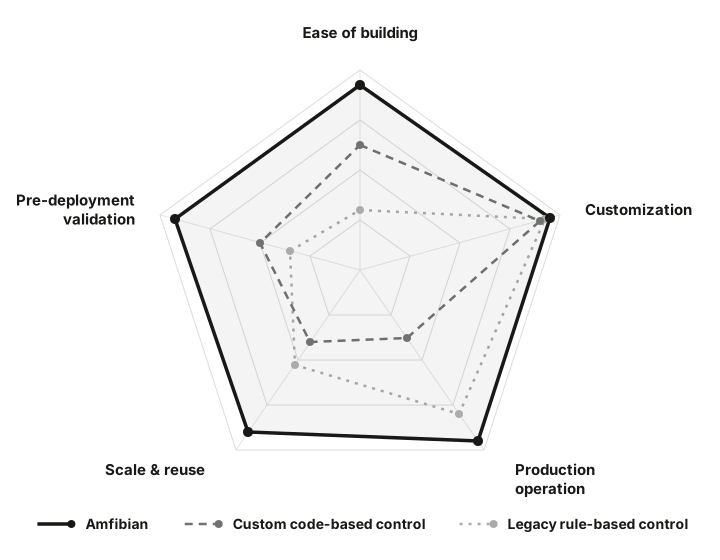
A conceptual comparison of the build and operating characteristics of legacy rule-based control, engineer-built custom code control, and Amfibian.
Legacy rule-based control: production-ready, but limited in what it can express
Many fabs already operate APC or R2R platforms where engineers combine arithmetic, conditions, limits and simple rules to calculate the next recipe. Data connections, execution timing, permissions and operating procedures are already in place, so validated logic can run reliably for years.
The limitation appears as control logic becomes more complex. Nonlinear multivariate relationships, Virtual Metrology, anomaly-based gating or combinations of multiple models can exceed what a rule-oriented platform expresses comfortably. The problem is not production operation; legacy platforms are often strong there. The constraint is flexibility, development speed and reuse of more complex logic.
Custom code-based control: flexible enough to exceed legacy limits, but the team owns the system around the code
Process engineers or data scientists analyze data and write process-specific models, calculations and exception logic in Python, R or similar code. This provides much more freedom than arithmetic and rules.
That freedom comes with responsibility for productionization: data integration, triggers, invalid inputs, safety bounds, validation, monitoring, updates and rollback. As products and tools multiply, similar infrastructure tends to be rebuilt project by project.
Amfibian: combining flexible control logic with a repeatable production workflow
Amfibian standardizes the work around the logic. Engineers configure models and control logic in Studio, validate them with a Digital Twin, and operate validated packages through Runtime. DOE, Virtual Metrology and Process Control Apps share the same data, validation and operating structure.
The point is not that one built-in algorithm is always better. Different equations, statistical models and machine-learning models can be used, while the surrounding build, validation, deployment, operation and change-management workflow stays common.
The difficult work in production starts after the control value is calculated
Real fabs still need to know which version is running, when a result is valid, what to do with missing inputs, how to enforce safe bounds, how to detect when assumptions no longer hold, and how to roll back.
Legacy platforms have solved much of this operating problem for years, but are constrained in how quickly complex new logic can be expressed. Custom code removes much of that constraint, but shifts build and operating responsibility back to the team. Amfibian is intended to connect the flexibility of newer models and code with a production-grade validation and operating structure.
As the number of products, tools and processes grows, shared operating structure matters more. Otherwise each control project creates another data connection, validation method, deployment procedure and set of operating rules.
※ This comparison is conceptual. Actual suitability depends on process characteristics, existing systems, engineering resources and operating requirements.